A couple of months ago, I published a tirade against the industry of strategy development (one which I am very much a part of). Now its time for a more constructive response.
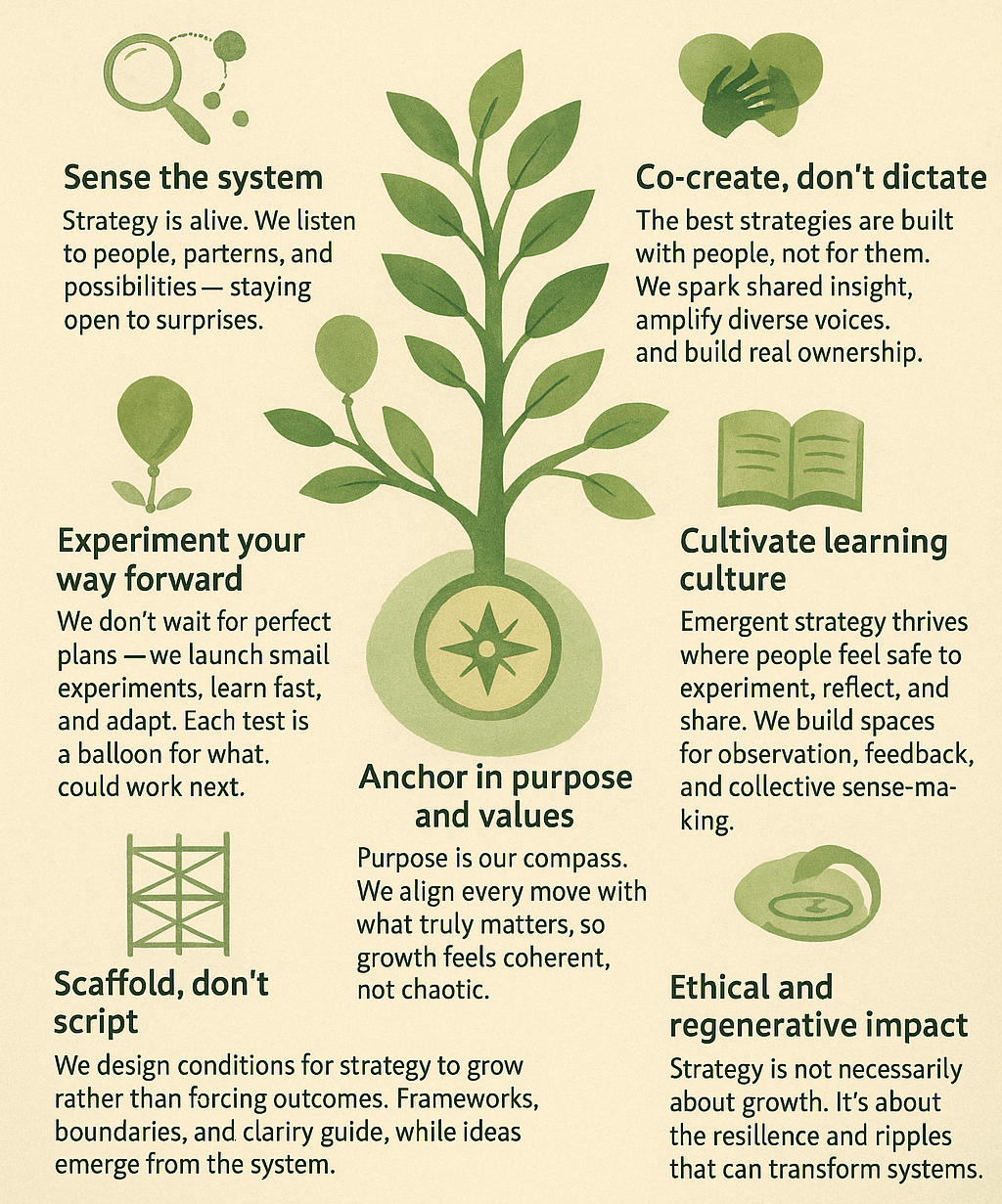
Inspired in part by my own lived experiences (both good and bad!) working in strategy co-creation, I have developed a set of principles to guide my work co-creating strategy with organisations.
I am inspired by the teachings of emergent systems thinkers and leaders, most notably adrienne maree brown, who set me off down this path, and to a diverse community of practitioners who have been my thinking partners in this work.
As I shared in the last blog, the idea of a 5-year fixed plan can feel appealing; it gives us an illusion of control in a world full of chaos and struggle. But it is just an illusion, and it sets us up to fail. This blog led me into conversation with many other practitioners disillusioned with conventional approaches to strategy.
In turn, this led me into a process of reimagining strategy, and the role of ‘consultant’ within that. And now, I’m shifting into a new posture.
I help design emergent conditions so that strategy can evolve iteratively.
Rather than getting swallowed up in narrowly framed objectives and endless metrics, I am making an intentional shift to being more explicit in my emergent approach. This means using adaptive frameworks as I work alongside organisations, enabling clarity whilst remaining open to signals around us.
There is no doubt that emergent strategy demands more from us as leaders. It is an ongoing process of sense-making, relationship building and collaboration. No more command and control; this is a relational approach to change-making.
For those of you who would like to read more about this approach, I’ve created a 5-page explainer including a visual summary, set of emergent strategy principles, outline of my consultancy approach, as well as signposting to resources and tools created by others. I would love to have your feedback as I evolve and develop this work. The more of us that engage with emergence, the easier it will become for us all to let go of that illusion of control and lean into the new possibilities that this opens up.